
What a Horse Named Dakota Taught Me About Leadership
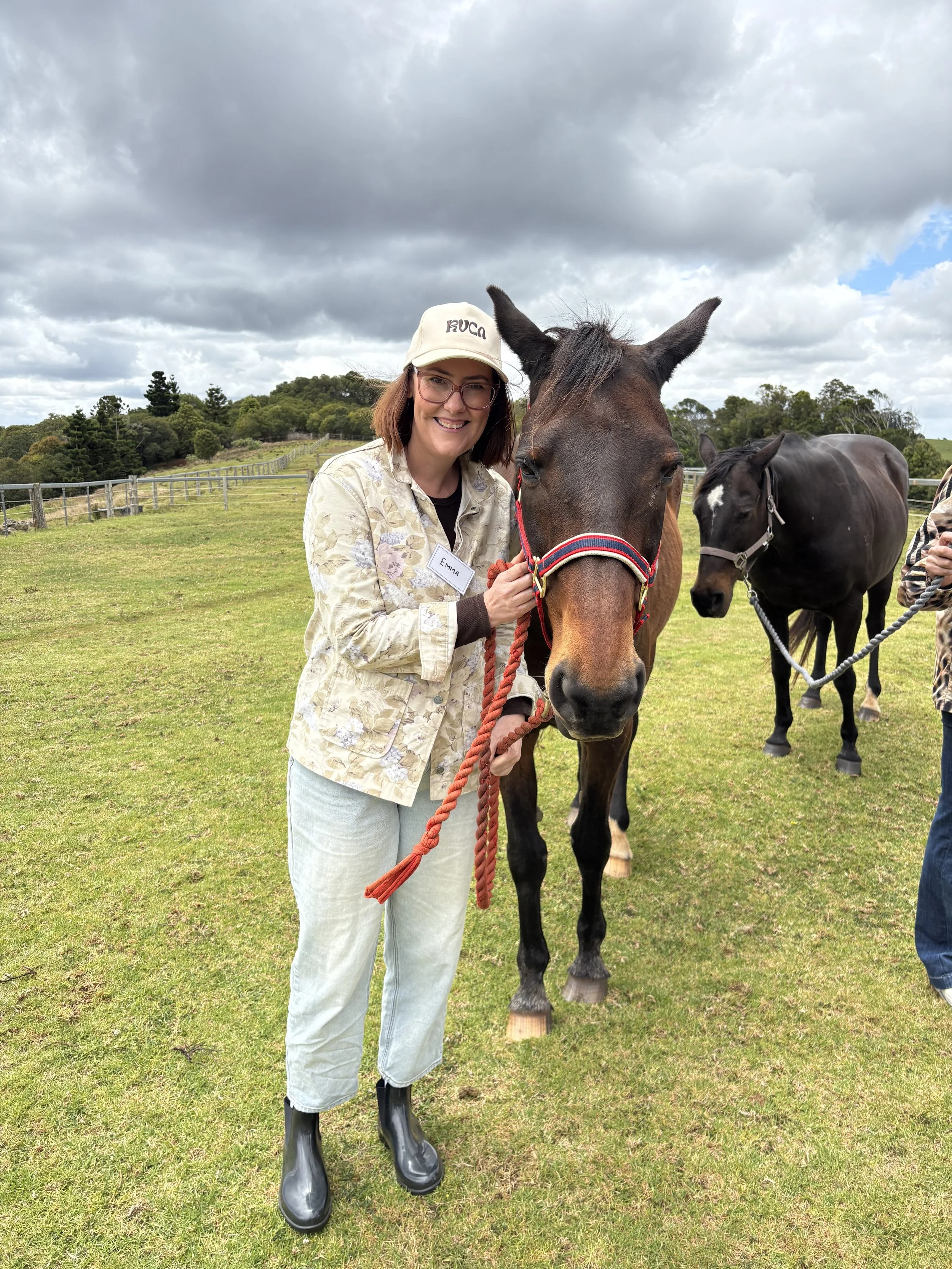
I was recently invited along as a guest to an equine-assisted leadership session. I'd been really looking forward to it, and I'll admit I also turned up with a lot going on in my head. I've been carrying a bit of anxiety lately, the kind that follows you from one task to the next.
It was also absolutely freezing. I was standing in a paddock with a group of people I'd never met, cold right through, and I think that cold did me a favour. I couldn't think about my inbox or the stack of tasks and deadlines because all I could think about was how cold I was, and that pulled me into the moment in a way I don't often manage.
Being out on the land with the animals did something for my nervous system that I didn't expect. By the end of the morning I felt calmer and more settled than I had in weeks. I came home with a few leadership lessons I haven't stopped thinking about, and most of them came from a horse named Dakota, who was honestly the sweetest little thing.
Presence comes first
My first instinct when we arrived was to rush straight over to the horses and say hello. Right alongside that was a real sense of apprehension. They're big animals, I didn't know them and they didn't know me.
Horses notice everything. They're incredibly perceptive and pick up on what's happening around them long before we do. Standing there, I realised that if I wanted to connect with them I'd have to slow down and actually be there, rather than half there with my mind somewhere else.
That's a pretty good description of what our teams need from us too. So much of leadership happens while we're thinking about the next meeting, the email we haven't answered or the decision waiting for us tomorrow. People can tell when we're only half listening, and it's hard to build trust with someone who is only half in the room.
Relationships have to be built
An early exercise was all about relationship. Before we asked anything of the horses, we spent time grooming them and noticing how they responded. Where did Dakota relax? What made him shift his weight or step away? What was he telling us without making a sound?
It reminded me that working alongside someone isn't the same as having a relationship with them. Trust comes from time and attention, from getting to know what makes a person feel safe, what helps them do their best work and what they might be telling you that they haven't said out loud. When leaders skip that step, even the best plans tend to stall.
Notice the systems and the patterns
Horses don't live as individuals. They live in a herd, with relationships and an order that were there long before we turned up. Watch for a while and you start to see the patterns: who moves first, who keeps their distance, who follows whom.
Workplaces are the same. When someone disengages or a team stops working well together, it's natural to look at the individual and ask what's going on with them. Often the more useful question is what's going on around them. What patterns have formed over time? Which relationships are shaping how people behave? What has the team quietly learned to put up with? People respond to the system they're in, and sometimes the change that helps most is a change to the system rather than to the person.
Who is leading who?
This is the moment that has stayed with me. After building the relationships through grooming, we took the horses for a walk around the paddock. I was paired with another participant, and to start with Dakota didn't want to go with her at all, so I took the lead rope. He came with me straight away, walking freely, and I was feeling pretty pleased with how we were going.
Then Jess, our facilitator, asked me, "What are you noticing here? Who is leading who?"
I paused and realised Dakota was out in front and I was trailing behind him. He was cutting corners and taking shortcuts around the paddock, and I was going wherever he wanted to go. Because in my head he trusted me. I had the lead rope in my hand, but ultimately he was the one leading.
We'd built a lovely relationship, but I hadn't told him where we were going. Jess explained that horses will happily go where you ask, but you have to ask clearly and with an energy that says you mean it. Sometimes leadership needs you to be assertive. Once I got clear in my own head about where we were heading and showed him with my body and my energy, he came with me.
I see this all the time in the businesses I work with. Leaders who care deeply about their people and have put real effort into good relationships can hold back from setting clear direction because they don't want to upset anyone. Their teams end up finding their own way around the paddock, usually with the best of intentions, because nobody has said clearly where they're going. Clear expectations are a form of care, and in my experience most of the tension in teams comes from expectations that were never made clear, rarely from expectations that were too high.
Energy says what words can’t
We couldn't use words with the horses, so everything we communicated came through our energy and body language. Dakota could tell when I was unsure, and he could tell the moment I'd made up my mind.
People are just as perceptive, even if they're more polite about it. Our teams read our tone, our pace and our mood long before they take in what we're saying. If we say we're calm while rushing around the office, or say we trust someone and then check every detail of their work, they'll believe what they see. A good question to ask yourself is what you're bringing into the room and how it feels for the people around you.
Why this matters more now
I've been thinking a lot about where leadership is heading as technology and AI change how we work. These tools are brilliant at helping us move faster, process more information and get more done, and I'm a big fan of what they can do.
What they can't do is be present with another person. They can't build trust with a nervous new starter, notice that a team meeting has gone quiet, or see the pattern playing out between two people who've stopped talking to each other. Those skills belong to us, and the busier and more digital our working lives become, the more deliberately we need to practise them.
For me, that practice started on a freezing morning in a paddock, with a group of strangers and a very sweet horse who showed me I was following when I thought I was leading.
What I'm taking back into my work is simple enough: slow down enough to be present, put real time into relationships, look at the patterns and the system as well as the person, pay attention to the energy you bring, and when it's time to lead, be clear about where you're going.
Bring experiential learning into your leadership program
If you're building or refreshing a leadership program, I'd really encourage you to include some experiential learning like this. So much leadership development happens in a training room or on a screen, and there's a place for that, but what struck me on the land was how quickly the lessons stuck because I felt them rather than just heard them. I'm still thinking about that one question from the facilitator.
Taking leaders out of the office and into a completely new setting, with an animal who can't be talked around, shows them how they actually lead in real time. It's also a lovely way to bring a leadership team together, because everyone is learning something new at once and nobody gets to be the expert.
A big thank you to Jessica Marshall for having me along, and to Warren for hosting us at the stunning The Wagon Stop Wellness Farm . If you'd like to explore equine-assisted leadership for your own team, I can't recommend her work highly enough. You can find out more at www.jessicamarshall.com.au
If you're a founder or leader working through some of this in your own business, I'd love to chat. It's the work I do every day as an HR consultant, with growing businesses on the Gold Coast and beyond.